Unblurring a Hit-and-Run
I used math to recover a readable license plate from a motion-blurred photo of a hit-and-run car.
I took a blurred, unreadable photo of a hit-and-run car’s license plate and made it legible using an algorithm built for deep-space telescopes.
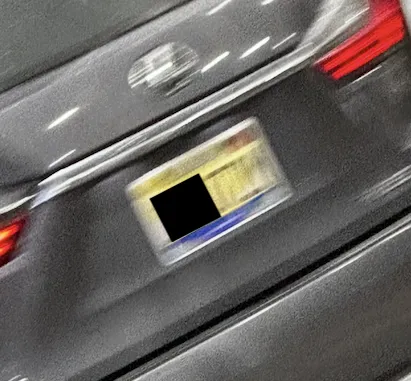
Someone in my area posted about a hit-and-run. They had a photo of the plate, but it was a smeared mess. You could not read a single letter.
I zoomed in. The blur was smooth and straight - not the random shake you’d expect from a shaky hand. It looked like pure linear motion. And if the blur follows a clear pattern, you can reverse it.
That reminded me of the “Mr. Swirl Face” case. A man hid his face in photos with a spiral filter. Police just reversed the filter. Same idea here: if the math is known, you can undo it.
How motion blur works
A moving object smears each point of light along its path. That smear is described by a convolution:
blurred_image = sharp_image * blur_kernel
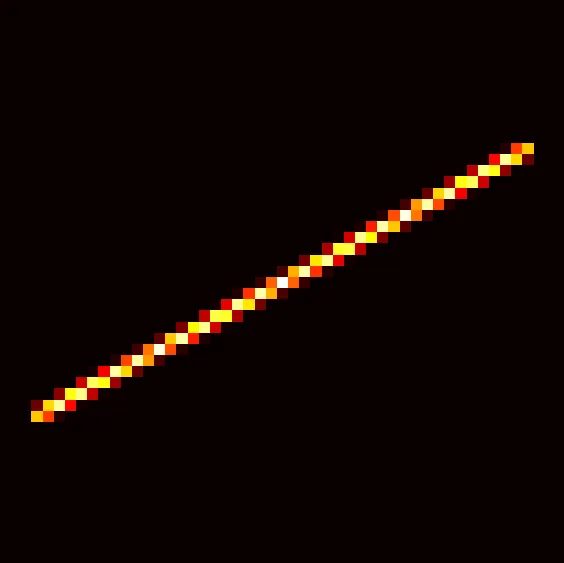
The blur kernel is a small image that maps how each dot of light gets spread. For straight-line motion blur, the kernel is just a line - at the angle of motion, with a length that matches the blur distance.
If you know the kernel, you can try to undo the blur. That’s called deconvolution.
The algorithm
I found the Richardson-Lucy algorithm, first built for cleaning up telescope images. It guesses the sharp image, then refines that guess over and over:
for _ in range(iterations):
    # What would our estimate look like if blurred?
    conv = fftconvolve(estimate, psf, mode='same')
    # Where does the model under/over-predict?
    ratio = blurred_image / conv
    # Back-project the error and update
    correction = fftconvolve(ratio, psf_flipped, mode='same')
    estimate = estimate * correction
Each pass sharpens the result. This isn’t just a filter - it converges on the most likely sharp image given the blur. It’s grounded in statistics.
Building the kernel
The kernel needs to match the real blur. For linear motion, that means two values: the angle and the length in pixels.
I drew an anti-aliased line at the target angle, spreading each sample across nearby pixels with bilinear weights:
def create_motion_kernel(length, angle):
    size = length * 2 + 1
    kernel = np.zeros((size, size), dtype=np.float64)
    center = size // 2

    angle_rad = np.radians(angle)
    cos_a, sin_a = np.cos(angle_rad), np.sin(angle_rad)

    # Oversample at 4x resolution for anti-aliasing
    for i in np.linspace(-length, length, length * 4 + 1):
        cx, cy = center + i * cos_a, center + i * sin_a
        # Distribute to 4 nearest pixels via bilinear interpolation
        x0, y0 = int(np.floor(cx)), int(np.floor(cy))
        fx, fy = cx - x0, cy - y0
        for (x, y, w) in [(x0, y0, (1-fx)*(1-fy)), (x0+1, y0, fx*(1-fy)),
                          (x0, y0+1, (1-fx)*fy), (x0+1, y0+1, fx*fy)]:
            if 0 <= x < size and 0 <= y < size:
                kernel[y, x] += w

    return kernel / kernel.sum()
Anti-aliasing might not be critical, but jagged edges could hurt the end result.
Finding the right values
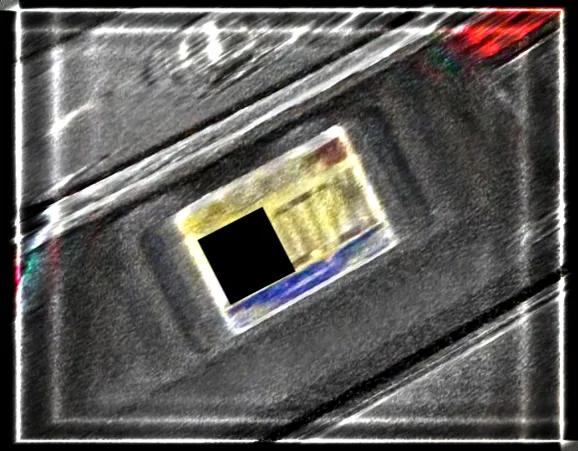
This part was pure trial and error. I built a small tool with sliders for angle and length that showed a live preview of the deblurred result. I dragged sliders until letters started to show up.
I landed on angle 149.5, length 25. Characters began to emerge.
To check the angle, I looked at the power spectrum of the blurred image. Motion blur leaves dark bands in the frequency domain, at right angles to the blur direction. Those bands pointed to ~61.5 degrees - which means the blur runs at ~151.5. That small shift from 149.5 to 151.5 did help.
Refining the kernel
A perfect straight line is an ideal. Real motion has acceleration and small wobbles. So I let the algorithm refine the kernel itself:
- Deblur the image with the current kernel
- Re-estimate the kernel from the sharp guess and the blurred image
- Repeat
The kernel update uses the same math, but flipped - solve for the kernel given a known image instead of the other way around:
def estimate_kernel(blurred, sharp, kernel_size, current_kernel, iterations=10):
    kernel = current_kernel.copy()
    sharp_mirror = sharp[::-1, ::-1]

    for _ in range(iterations):
        conv = fftconvolve(sharp, kernel, mode='same') + 1e-12
        ratio = blurred / conv
        correction = fftconvolve(ratio, sharp_mirror, mode='same')

        # Extract kernel-sized region from center
        ch, cw = correction.shape[0] // 2, correction.shape[1] // 2
        kh, kw = kernel.shape
        kernel *= correction[ch-kh//2:ch-kh//2+kh, cw-kw//2:cw-kw//2+kw]

        # Physical constraints
        kernel = np.maximum(kernel, 0)
        kernel[kernel < 0.01 * kernel.max()] = 0  # compact support
        if kernel.sum() > 0:
            kernel /= kernel.sum()

    return kernel
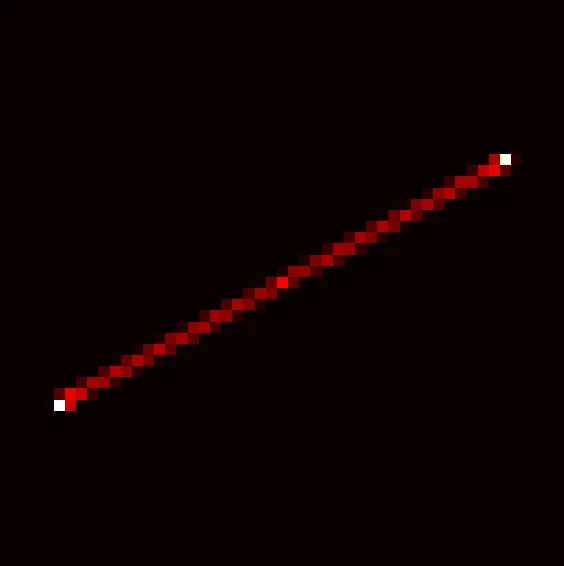
After 20 rounds, the kernel barely changed between passes. It was still a straight line - the blur really was linear - but the weight along it was no longer even. The camera was likely speeding up or slowing down during the shot.
The result
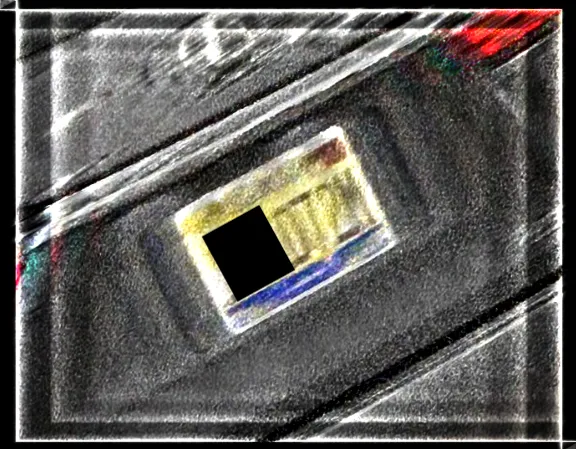
I could read the plate. Not perfectly - deconvolution can’t create detail that was never captured. But enough to make out the characters, which was the whole point. I sent the plate number to the hit-and-run victim.
What I learned
The big thing I learned is to think about images as signals when processing. It was possible to see the angle of the blur very clearly in the frequency domain after applying a Fourier transform.
How I used AI
I’m not a signal processing expert. I’m a software developer who saw a problem and thought “I bet that’s reversible.”
LLMs filled in the gaps. They walked me through the math behind Richardson-Lucy. They told me why my FFT convolution needed padding. They pointed me to kernel refinement when I asked how to push further.
The core ideas were mine - spotting the linear blur, tuning the values by eye, choosing to iterate. But AI turned what would have been weeks of research into an afternoon.
That’s what AI-assisted development looks like: a person with a goal and instincts, using AI to fill in the parts they don’t know by heart.
The full source code is available as a GitHub Gist.